Disguise
The People UpstairsDisguise is the central condition of the Greenes’ life on Earth, allowing two Milotan agents to inhabit a human society while concealing bodies that are humanoid but not fully human. It is not a single mask or deception but an entire technological, bodily, domestic, and social system. Its purpose is survival and concealment; its cost is permanent vigilance, financial strain, bodily irreversibility, and the danger that even a child’s ordinary schooling may expose what the family has hidden.
Definition and Material Form
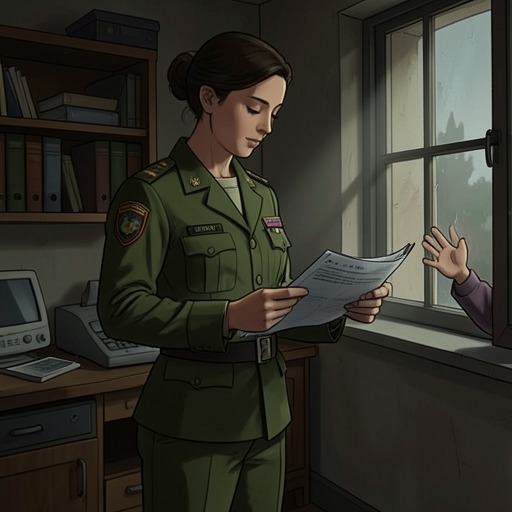
The disguise begins with the body itself. Dan Greene’s natural face is a dull, reasonable light green, and his eyes have restrained maroon pupils; his hands are broad enough to support more than five fingers. May Greene’s altered appearance likewise conceals a nonhuman form. When she returns from New York City after seeing Dr. Robinson, she peels a silk-thin plastomask from her face and removes her Milotan contact lenses. These devices transform visibly alien features into a surface that can pass within ordinary human surroundings, but they do not erase the underlying body. The narrative repeatedly makes the disguise feel close to the skin rather than identical with it: a removable layer, a practical covering, and a reminder that the apparent human self has been manufactured.
The Greenes extend this process beyond their faces and eyes. May’s long hair is her own, but she has dyed it an Earth pepper-and-salt color. A terrestrial hairbrush has been subtly altered to fit her needs, because Milotan artifacts cannot safely be left in the apartment. Their home is filled with conventional department-store furniture in brown monotones and tweedy textures, the sort of decor that had been fashionable when they moved in, yet beneath its banality lies an emotional impression of alienness. Even the apartment must therefore function as a disguise: it presents an ordinary domestic surface while containing traces that only a sufficiently perceptive visitor might sense.
The disguise is also a bodily adaptation imposed for a lifetime assignment. The Greenes have undergone changes that include amputations, leaving them as monstrous on Milotis as their natural forms would appear on Earth. They cannot simply return home and resume their former identities, nor can they expect reassignment to another Earth post. Their apparent human life is thus not a costume that can be discarded at will. It has become a permanent condition whose protections are inseparable from irreversible damage.
Disguise as Family Practice
May Greene’s pregnancy turns the private system of disguise into a crisis of reproduction. She and Dan Greene had been sent to Earth partly because the Bureau believed May sterile or past childbearing. Once she becomes pregnant, the couple fear disgrace and recall, while recognizing that both share responsibility, that their precautions have failed. Dr. Robinson offers to terminate the pregnancy without reporting it to Milotis, but May refuses because she has wanted a child all her life. Her desire makes the disguise morally and emotionally unstable: preserving the secret may require sacrificing the child, while keeping the child may expose the entire assignment.
Dan Greene initially sees the practical danger with particular clarity. A baby could perhaps remain at home under constant supervision, but compulsory schooling at about six would bring medical examinations and other scrutiny. Even a superficial examination might reveal the truth, and the family would live in continuous fear of discovery. His concern is not a lack of love. He knows May would comply if he insisted, yet he refuses to demand an abortion, explaining that he had imagined spending the rest of his life on Earth and had become accustomed to its life despite disliking the secret-agent role and the human natives. The disguise has therefore shaped not only what the couple show others but also what future they believe they can endure.
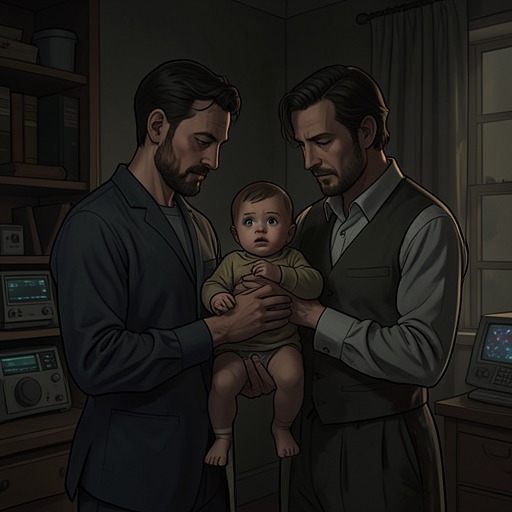
Terence Greene is born eight months later on Earth, in the United States of America, with a genuine birth certificate and citizenship. Because he has no second name on Milotis, he is unlike his parents in one decisive respect: his public identity is not based on forged papers. Yet his body still requires concealment. Dr. Robinson fits the baby with small masks and lenses in a laboratory unusually complete for a New Jersey general practitioner. Milotan children grow more slowly than terrestrial children, which gives the disguises a little more time to remain usable, but their expense still strains the Greenes’ finances. May must leave her job to care for the child, while Dan continues working, and the loss of her income aggravates the already high cost of living on an alien planet.
The domestic burden is intensified by the fact that Terence’s physical needs must be managed through Earth customs. On Milotis, robots would have cared for a baby, but on Earth May must perform the work herself. The disguises consequently turn motherhood into technical maintenance as well as affection: masks and lenses must be purchased, fitted, replaced, and kept secret while the child grows. May sometimes spoils Terence out of guilt because she does not receive the pleasure from him that she had expected, then feels remorse for having judged him and gives him things he wants even when they are not good for him. Her ambivalence shows how concealment enters the emotional life of the family, making the child both beloved son and continual reminder of the danger created by the failed disguise.
Social Cover and the Child’s Education
The Greenes teach Terence that he is different before they tell him why. They speak both Milotan and English at home so that he will know both languages, warn him never to use Milotan in public, and keep him away from other children as much as possible. At first they tell him only that they came from a far-off place. Dan Greene wants the truth revealed quickly so that Terence will not identify with humans, while May Greene believes he will discover that he is an alien soon enough. The family’s language policy and isolation are therefore parts of the disguise, designed to make a concealed identity usable rather than merely to hide a face.
When Terence Greene reaches six, school becomes unavoidable under the Compulsory School Attendance Law. May chooses a private day school, seeking the best limited educational advantages available on Earth while ensuring that he can return home each day. She tells the principal that the Greenes are Christian Scientists and therefore should not be subjected to medical examinations. The explanation is a socially recognizable shield: it turns refusal into a religious practice and allows the school to accept an unusual child without asking what lies beneath his coverings. The school’s expensive fees make the principal especially understanding, showing that class position and money temporarily reinforce the disguise.
Terence’s first day seems to confirm the arrangement. May waits anxiously, searches his childish mask for signs of distress, and learns that he has managed the other children without apparent trouble. His questions, however, show that the disguise is already becoming an object of knowledge. He notices that the other children do not wear face masks or lenses and then wonders whether the teachers do. What adults treat as a private secret is becoming, for Terence, a visible difference that requires explanation. The masks protect him from observation while also teaching him to observe the divide between his body and the bodies around him.
The surrounding tenants supply an additional, less controlled layer of social cover. Old Mrs. Danko senses that something is subtly different about the Greenes and mutters about the Evil eye. She later calls them “Commissars!” and makes a sign against the Evil eye, while neighbors treat the family as suspicious in a way they do not treat other residents. May understands that the truth would be far more terrible to them than their vague suspicions. Their rumors therefore help the disguise by providing false explanations, but they also expose the emotional violence of being read as an outsider. “Changeling” is suspected under the breath, and the family’s difference is translated into folklore, political fear, or foreignness rather than recognized as alien biology.
Exposure and the Disguise’s Flexibility
The decisive weakness appears when Terence’s school introduces swimming lessons. The event threatens the concealment of the body more directly than ordinary classroom contact, and Terence returns home with difficulty, explaining that swimming has begun in his grade. May realizes that the school’s genteel atmosphere has never protected the family from a situation in which bodies are displayed before one another. Terence tells her that he is different, and the statement functions as an accusation: his parents have made him alien to the human world without telling him the full reason.
The principal’s reaction reveals an unexpected flexibility in social interpretation. She reproaches May for not warning her that the boy was a “freak” and says that the episode could have been prevented if she had known. Yet she does not infer Milotan biology. Instead, she decides that Terence’s condition confirms rumors about radiation from bombs and a governmental cover-up connected with the bomb race. The principal’s assumptions allow the family’s concealment to survive. Human observers do not necessarily discover the truth when the disguise fails; they often replace the unexplained fact with a familiar story about mutation, war, or political deception.
May immediately adjusts the cover story to fit this interpretation. She presents Terence’s condition as possibly connected with her age and with a doctor’s initial suspicion that the pregnancy was a tumor, while maintaining the suitable appearance of grief. Her relief is so great that she nearly laughs, but she controls that response because visible joy would contradict the social meaning of the scene. Disguise thus includes performance after exposure: May must not merely conceal physical difference but display the emotion that makes the observer’s preferred explanation credible.
The same pattern surrounds the family’s supposed origin. When neighbors connect the Greenes with Russia or a Balkan region, Dan Greene decides that the Russian story should stand, implying that they come from a Balkan state absorbed by a larger power and remain quiet because relatives might face reprisals. A false nationality becomes another protective layer. It is easier for the humans to believe that the Greenes are foreign political refugees, radiation victims, or religiously unusual parents than to imagine life beyond Earth. The disguise succeeds not because it is flawless, but because observers interpret visible anomalies through the narrowest explanations available to them.
Revelation and Significance
The disguise finally becomes an object of direct explanation between parents and child. After the swimming-lesson crisis, Terence asks whether his parents have invented their account merely to deceive him. May tells him that Milotis truly exists and promises that she and Dan will explain everything at home. The revelation does not immediately remove the physical coverings: she still pats the plastoskin encasing his small, mutilated hand. The scene joins truth and concealment in a single gesture. Terence can learn the name and reality of his origin while remaining materially disguised before human society.
May also announces that the family will send a beam back to Milotis telling the Bureau all about him. Communication technology converts the secret child into an official report, linking the household on Earth to the government that dispatched his parents. The beam is the administrative counterpart to the masks: one conceals the body locally, while the other discloses the child across interplanetary distance. Together they show that identity is produced through networks of technology, bureaucracy, family loyalty, and public recognition.
Disguise consequently carries a double meaning. It is a practical defense against medical examinations, compulsory schooling, neighborhood suspicion, and institutional exclusion, but it is also a condition of alienation. The Greenes have adapted their bodies so extensively that return to Milotis is difficult, while Terence grows up speaking two languages, wearing coverings, and learning that the people around him do not share his physical reality. The story’s irony lies in the fact that Earth society repeatedly misreads the evidence: it sees foreignness, radiation, witchcraft, or a changeling where there is a Milotan family. The disguise is powerful not because humans see nothing, but because they see difference and explain it in human terms.